

10 Interior Design Mistakes That Are Quietly Making Your Home Feel Unfinished

There is a particular kind of frustration that comes from finishing a room and still feeling unsettled in it.
You've chosen the furniture, hung the art, added the pillows, and invested real time and money into making your home beautiful. And yet, something about the space still feels almost there rather than complete.
That feeling isn't in your imagination, and it isn't a sign that you lack a design eye.
More often than not, it points to a handful of quiet, fixable mistakes that are easy to miss because they are so common.
“Every wise woman encourages and builds up her family, but a foolish woman over time will tear it down by her own actions.”
That phrase—over time—matters.
A home is built up through small, repeated choices. And the same is true of the choices that can quietly work against a room.
Today, we're naming ten of the most common interior design mistakes so you can finally close the gap between the home you have and the home you've been picturing.

Why Can a Beautiful Room Still Feel Unfinished?
So many women reach a point where they have genuinely invested in their homes, financially and emotionally, and still walk into a room and feel a quiet disappointment they can't quite name.
It's not necessarily that the furniture is wrong or the colors are unattractive.
It's that a series of small decisions, made without a clear plan, have added up to a space that doesn't feel cohesive.
You can spend real money and real time on a room and still feel like it doesn't reflect who you are, that it's missing a sense of intention, or that it simply hasn't come together the way you hoped.
This can create a quiet insecurity around design decisions altogether. When a room doesn't feel finished after you've put so much effort into it, it's easy to assume you simply don't have the right taste or a "design eye."
In reality, it's often much simpler than that.
These are specific, identifiable patterns that show up again and again in homes at every price point. Once you know what to look for, you can begin to see them—and address them.
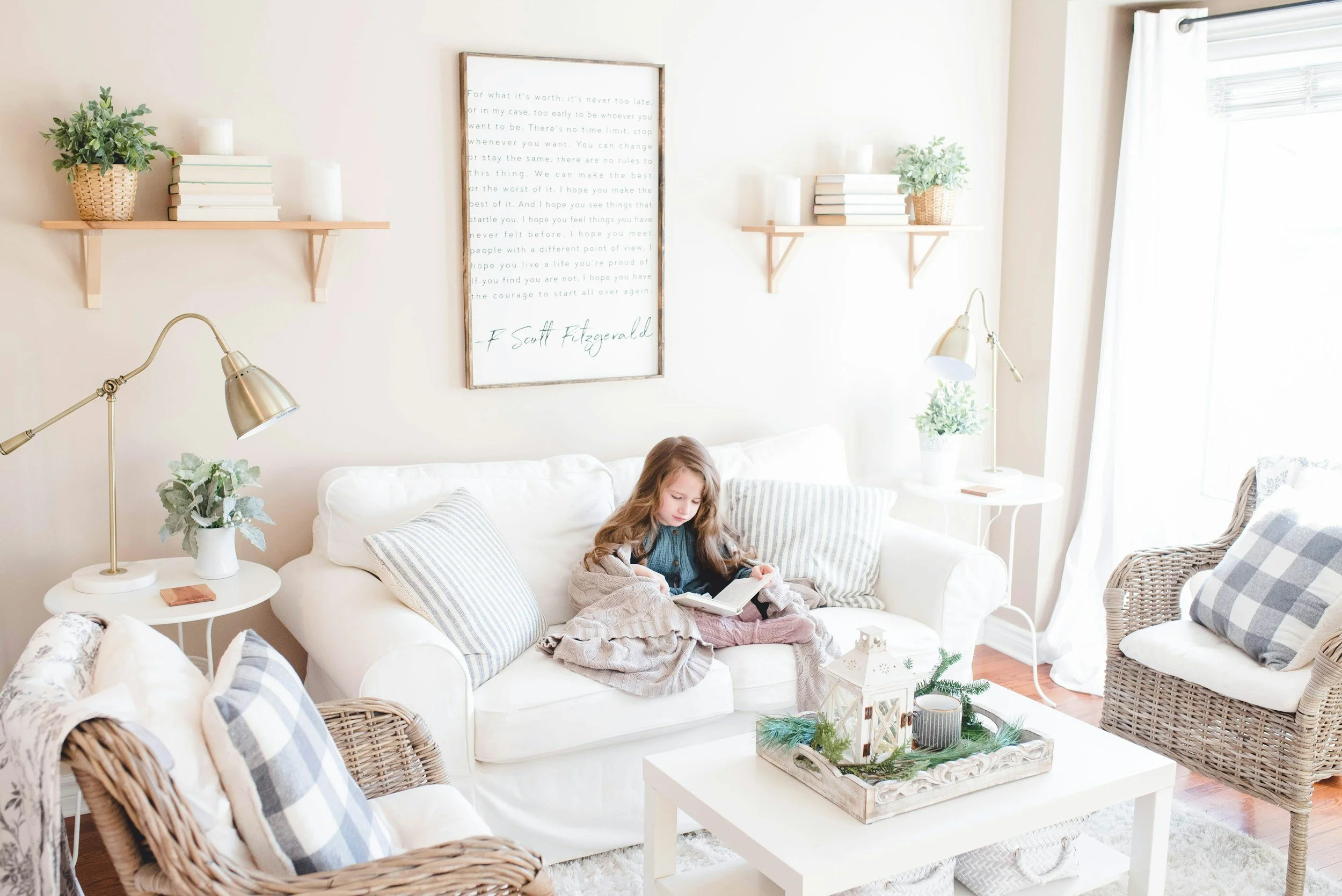
10 Interior Design Mistakes Making Your Home Feel Unfinished
The ten mistakes fall into three categories: scale and proportion, layering and finish, and intention and style alignment.
Let's look at each one.
Category One: Scale & Proportion Mistakes
The first category is about the relationship between the size, placement, and visual weight of the things in your room.
These mistakes often create an immediate feeling that something is "off," even when you can't explain exactly why. That's because your eye registers proportion instinctively, long before your mind can put words to it.
1. Choosing a Rug That's Too Small
A rug that's too small for your seating area can leave your furniture floating in the middle of nowhere instead of anchoring the room.
Rather than making the room feel larger, a small, undersized rug can actually make the space feel smaller and disconnected.
The right rug helps establish the seating area and gives the furniture a visual foundation.
2. Hanging Curtains Too Low or Too Narrow
Curtains have a surprisingly powerful effect on how tall and spacious a room feels.
When curtains are hung too low or too narrowly around the window, they crowd the window instead of framing it. The result is a visual interruption that can make your walls and ceilings feel lower than they actually are.
Extending curtains higher and wider helps emphasize the vertical height of the room and gives the window more presence.
3. Hanging Artwork Too Low
Artwork that sits too low or feels disconnected from the furniture beneath it can break the visual line your eye naturally wants to follow.
Instead of feeling intentionally connected to the room, the artwork can look like it was simply placed on an available section of wall.
The goal isn't to follow an arbitrary decorating rule. It's to create a visual relationship between the artwork, the furniture, and the surrounding space.
These aren't matters of taste. They're matters of proportion.
And proportion is something your eye notices immediately, even if your mind can't explain why a room feels off.

Category Two: Layering & Finish Mistakes
The second category is about the details that give a room warmth, depth, rhythm, and visual breathing room.
These are often the layers that separate a room that has simply been decorated from a room that feels thoughtfully designed.
4. Relying on a Single Overhead Light
A beautiful room can still feel flat and clinical when the only source of light is one overhead fixture.
One light source doesn't give the eye enough warmth or dimension to move through the room.
Layering your lighting creates depth. Think about different types of light serving different purposes throughout the space rather than asking one fixture to do everything.
5. Skipping Texture
Imagine a room filled almost entirely with smooth, similar surfaces.
Even if every piece is beautiful—and even if every piece is expensive—the room can still feel flat and unfinished.
Texture gives your eye something else to experience.
Soft fabrics, woven materials, natural elements, rugs, wood, and other tactile surfaces create contrast and dimension that make a room feel more complete.
6. Using a Color or Material Only Once
One of the quieter mistakes is introducing a color or material in only one place.
When something appears once and never shows up again, the eye doesn't have a clear path to follow through the room.
Repeating a color, material, or finish at least twice helps create visual rhythm and connection.
It's a subtle change, but repetition helps individual elements feel like they belong to the same story.
7. Filling Every Wall and Surface
A room doesn't feel more finished simply because every space has something in it.
When every wall, tabletop, shelf, and corner is filled, the result can actually feel cluttered and tense rather than calm and intentional.
Negative space matters.
Leaving some areas open gives the eye somewhere to rest and allows the pieces you've chosen to have more visual impact.
A room needs room to breathe.

Category Three: Intention & Style Alignment Mistakes
This is the category I care about most because these mistakes aren't really about the room.
They're about the plan behind the room.
You can have beautiful furniture, beautiful finishes, and beautiful accessories and still end up with a space that doesn't feel like you.
That's often a style alignment problem rather than a shopping problem.
8. Decorating for a Trend Instead of Your Identity
Trends can be fun to notice and explore, but decorating your entire home around what's popular can leave you with a room that photographs well today and feels wrong a year from now.
Why?
Because it was never really yours to begin with.
Your home should reflect your personality, your preferences, and the way you want to live—not simply what's appearing everywhere online.
9. Shopping Without a Cohesive Plan
This is one of the most common reasons a room feels disjointed after you've spent significant money on it.
You find a chair you love. Then a rug. Then a lamp. Then a piece of art.
Each item is beautiful on its own, but none of them were necessarily chosen to live together.
Without a cohesive plan, a room can become a collection of individual purchases rather than a connected design.
The answer isn't necessarily to stop shopping.
It's to stop shopping randomly.
10. Filling the Room With Filler Objects—or Ignoring Existing Finishes
This final mistake actually includes two closely related problems: adding things simply to fill empty space and choosing new elements without considering what's already permanent in the room.
Filler objects create visual noise without necessarily adding warmth, meaning, or story.
At the same time, ignoring your home's existing fixed finishes—your flooring, cabinetry, and trim—when choosing something new can create a quiet conflict throughout the space.
Everything you're adding needs to have a relationship with what is already there.
That is why a beautiful item can still feel wrong in your room.
It may not be a bad piece.
It may simply be the wrong piece for the story already being told by your home.

The Bigger Problem Isn't Shopping—It's Style Alignment
When a room feels unfinished, the instinct is often to buy something else.
Another pillow. Another piece of artwork. Another accessory. Another rug.
But sometimes more isn't the answer.
Sometimes the answer is stepping back and asking whether the pieces you already have are working together intentionally.
This is what I mean by a style alignment problem rather than a shopping problem.
The goal isn't to fill every empty space.
The goal is to make thoughtful choices that create a cohesive story throughout the room.
You Don't Have to Start Over
If you recognized your own home in even a few of these ten mistakes, take a breath.
None of them require you to start over.
They aren't a reflection of your taste, your creativity, or your worth as a homeowner.
They're simply patterns.
And patterns can be interrupted.
This week, walk through your home with fresh eyes.
Stand in the doorway of each room. Notice where your eye goes first. Notice where it feels stuck.
Look at the size and placement of your major pieces. Look at the lighting. Notice whether there's enough texture and breathing room. Then step back and ask whether the room feels like a cohesive expression of you.
You don't need to fix everything at once.
Choose one or two things to address first.
That single act of noticing is often the first real step toward a home that finally feels finished.
And you are so much closer to that than you think.
Let Your Home Feel Like You
Every home you've ever admired—in a magazine, on a screen, or in person—went through its own version of this process.
No room arrives at "finished" by accident.
And no designer, however experienced, gets every proportion and every layer right on the first attempt.
What separates a home that feels complete from one that feels perpetually in progress isn't necessarily a bigger budget or a more expensive designer.
It's the willingness to look clearly at what's actually happening in the room, name the pattern, and make one intentional adjustment at a time.
And that's good news.
Because you don't have to replace everything you own.
You don't have to tear everything down.
You don't even have to know exactly what's wrong.
You simply need a clearer way to see what's happening—and a plan for what to do next.
The Beautiful Room Makeover Experience™ is designed to take the guesswork out of those decisions and help you create a finished room you're genuinely proud to live in.
And if you're still working out where your personal style begins, the Interior Design Personality Quiz can help you identify what you're naturally drawn to, so your future design decisions have a clear filter behind them.
Your home doesn't have to be perfect.
It simply needs to feel intentional, cohesive, and like you.

Frequently Asked Questions
Do I need to redo my entire room to fix these mistakes?
No. Most of these ten mistakes can be addressed individually, often by adjusting placement, adding a layer, or removing a piece that no longer serves the room, rather than replacing everything in it.
How do I know which mistake is affecting my room the most?
Start by standing in the doorway of the room and noticing where your eye goes first and where it feels stuck. Scale issues tend to show up immediately, while intention issues, like a lack of a cohesive plan, often become clear once you look at the room as a whole rather than piece by piece.
Is it too late to fix a room I already spent a lot of money on?
Not at all. Many of these fixes involve rearranging or adding to what you already own rather than replacing it, which means your previous investment is rarely wasted.
What if I try to fix these mistakes and the room still does not feel right?
That is exactly what the Beautiful Room Makeover Experience™ is designed for. A second, trained set of eyes can often spot what is easy to miss on your own, and you do not have to figure it out alone.
Resource
Ready to stop guessing and get a room you're genuinely proud of? The Beautiful Room Makeover Experience gives you a guided path there. Let's hop on a quick call and see if it's the right fit for you.
Find Out More about The Beautiful Room Makeover Experience.