

No Matchy-Matchy! 3 Reasons Matching Everything Is Making Your Home Look Less Expensive (And What Designers Do Instead)
Here's a secret that surprises almost everyone: designers don't match.
If you've worked hard to make every piece in your home coordinate exactly, yet something still doesn't feel quite right, this post is going to set you free.
Today, we're looking at three reasons matchy-matchy doesn't work in interior design and what designers do instead to create a home that feels cohesive, collected, and luxurious. I'll show you why matching can flatten a room, erase your personal story, and even make your home look less expensive. More importantly, you'll discover how to bring your furniture, colors, textures, and finishes together without making everything look the same.
“For as the body is one and has many members, but all the members of that one body, being many, are one body, so also is Christ.”
I love this verse for a conversation about harmony because it reminds us that God never designed His people to be identical.
Each of us was made different on purpose, with unique gifts, personalities, and stories. Those differences aren't a problem to be solved. They're exactly what allow the body of Christ to function as one beautiful whole.
An eye is not a hand, and a hand is not a foot. Each part is needed precisely because it's different.
A well-designed room reflects that same truth in a small way.
Every piece can be a little different and still belong. The walnut table and the oak chairs, the floral pillow and the striped one, the antique chest and the newer sofa can live together in harmony because they share a common thread.
When you design your home this way, you're echoing something God built into His creation from the very beginning.
Unity was never about sameness. It's about each part being valued and working together in love.
And I think that's a beautiful reminder for our homes, too.
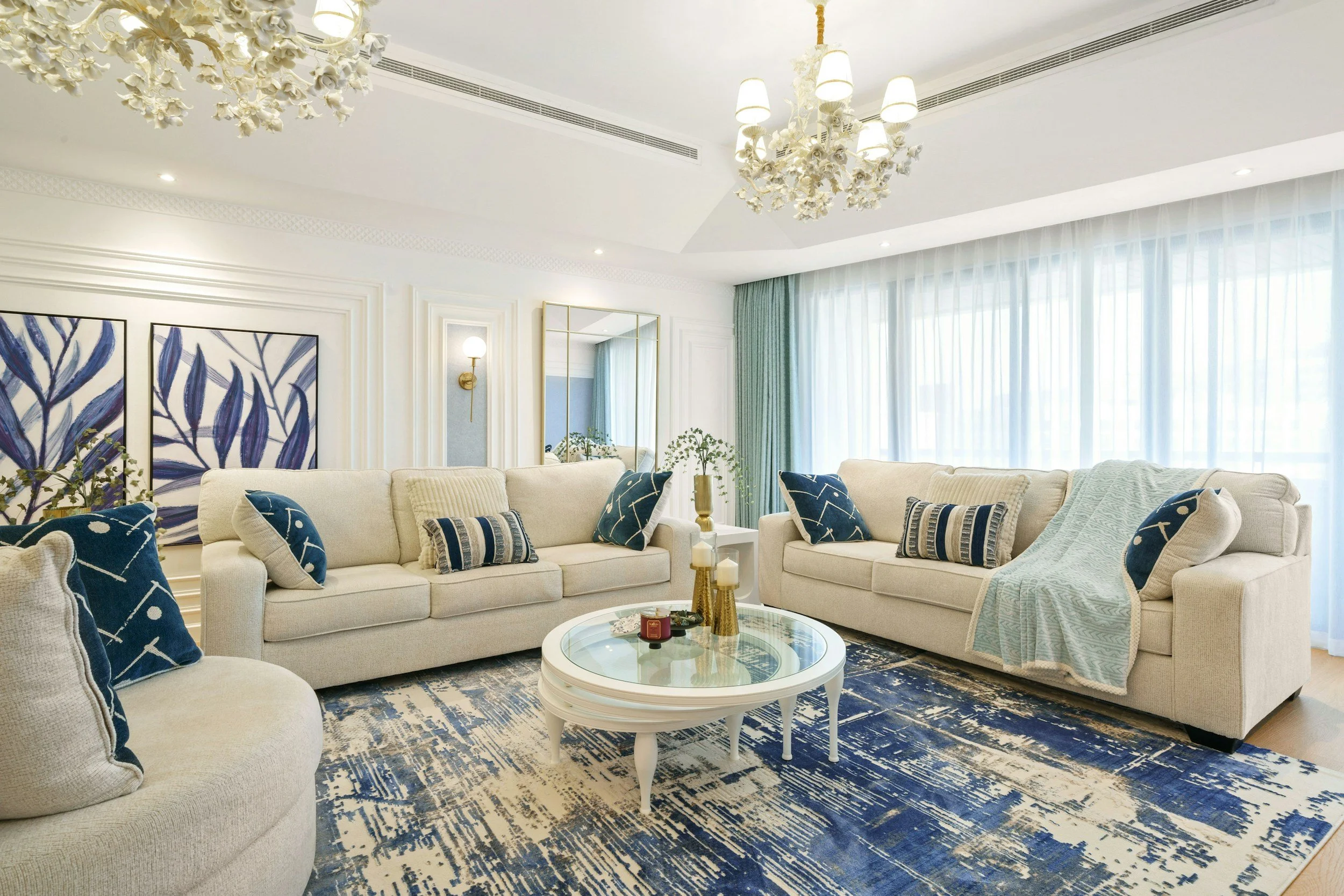
Sheree coastal living room, color contrast of sofa, throw pillows, window curtains
When Everything Goes Together but Nothing Feels Special
Picture a bedroom where the bed, both nightstands, the dresser, and the mirror all came as one five-piece set. The comforter arrived in a bag with matching sheets, shams, a bed skirt, and two coordinating throw pillows.
Down the hall, the dining chairs match the table, the end tables match the coffee table, and nearly every piece of wood in the house has the same warm cherry finish.
Everything goes together, and yet the rooms feel flat, a little dated, and not quite personal.
This is one of the most common situations I see, and it comes from a very understandable belief. Many women assume a designer's job is to make everything match exactly. When I walk into a home, I'm often asked, “Does this match?”
That question comes from a sincere desire to get things right. No one wants a room that looks like a mistake, and matching feels safe. If everything is the same, surely it must go together.
But here's the trouble: matching and harmony are two very different things.
Matching is about sameness. Harmony is about relationship.
A room built on sameness often feels lifeless, while a room built on relationship feels rich, intentional, and inviting. Once you understand the difference, you'll begin to see your home in an entirely new way. You may even discover that the pieces you already own can work together far more beautifully than you imagined.
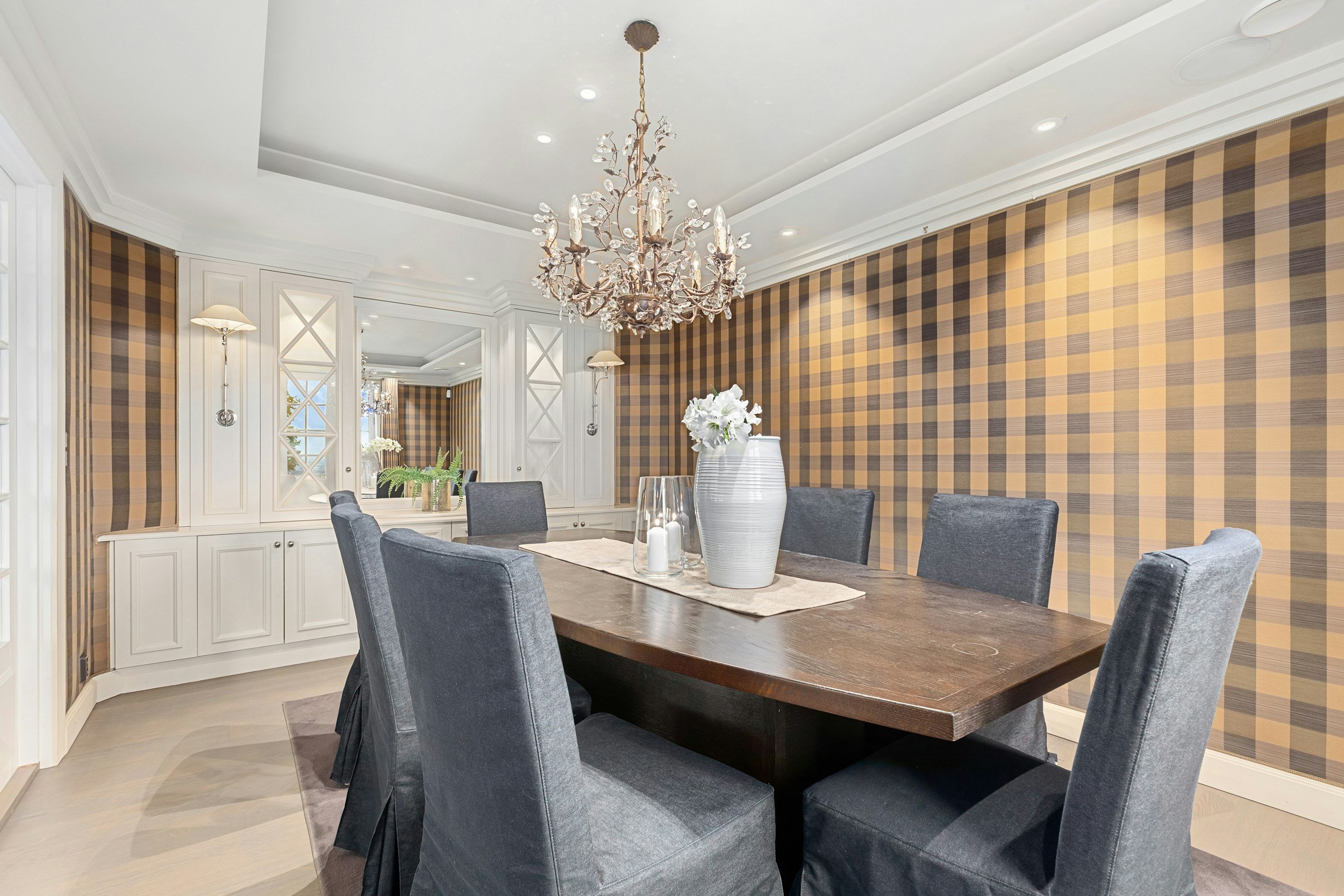
Sheree dining room, dark wood dining table with lighter upholstered chairs
Three Reasons Matchy-Matchy Doesn't Work in Interior Design
1. Matching Flattens a Room
The first reason matchy-matchy doesn't work is that matching flattens a room.
When every piece shares the same color, finish, and wood tone, the room loses its depth. Everything blends into one large mass, and the eye has nowhere to rest and nowhere to land.
Think about the most beautiful rooms you've ever stepped into. Chances are, there was contrast.
Perhaps a dark wood dining table was paired with lighter upholstered chairs. Maybe a smooth leather chair sat beside a nubby woven throw, or a crisp white sofa faced a warm wood coffee table.
Those differences created dimension, a focal point, and a natural rhythm that made the room feel alive.
When everything matches, nothing stands apart. A matched room can look tidy, but it rarely looks interesting, and it almost never draws you in.
The way a room feels is shaped by what your eye experiences. Contrast in color, texture, finish, and scale is what makes a space feel rich. Without it, even a room full of lovely furniture can feel flat, and many women never realize that matching is the reason.
The takeaway: If your room feels unfinished despite everything coordinating, it may not need more matching. It may need a little contrast.
2. Matching Erases Your Story
The second reason is that matching can erase your story.
When every piece comes from the same collection, a room looks as though it was purchased in a single afternoon. It feels more like a furniture store showroom than a home that has been lived in and loved.
The most meaningful homes feel collected over time.
There's the antique chest that belonged to your grandmother, the chair you discovered at a little shop on vacation, the painting that stole your heart, and the newer sofa you chose simply because it's wonderfully comfortable.
None of those pieces match, and that's exactly what makes them so beautiful together. They tell the story of a life.
Your home should reflect where you've been, what you love, and who you are. It doesn't have to look as though every item came from the same catalog to feel beautiful and intentional.
This is also where your Interior Design Personality Style matters.
A. Classic Dramatic: Your home needs bold contrast to feel alive. Matching everything can take away the drama and visual interest that make your style special.
B. Romantic: Your home is meant to feel collected, warm, and meaningful, never as though everything was purchased as a set.
C. Executive: Your home needs warmth and texture so your clean lines don't feel cold.
D. Ethnic: Your home is built around story, heritage, and handmade pieces that reflect who you are and where you come from.
Whichever style is yours, matching everything can work against it. When every piece looks the same, your personality can get lost.
But when your pieces harmonize, your home can tell your story in a way that feels natural, personal, and unmistakably yours.
3. Matching Can Make Your Home Look Less Expensive and Dated
The third reason may be the most surprising of all: matching can actually make a home look less expensive, and it can date a room quickly.
Matched sets are often tied to one store and one moment in time. When guests walk in, they can sometimes sense exactly when the furniture was purchased because the entire room belongs to a single era.
Harmonious rooms, by contrast, tend to feel custom. They look as though someone with a trained eye made thoughtful choices, piece by piece.
And that's what luxury looks like.
A room doesn't have to be filled with expensive furniture to feel high-end. It's the thoughtful combination of pieces, the contrast of textures, and the relationship between colors and finishes that can make a space feel sophisticated.
When you create harmony instead of matching everything, your home can feel more timeless, collected, and refined—even when many of your pieces are simple or affordable.
Speaking for a moment as a realtor, there's a practical benefit, too. Rooms that feel timeless and harmonious tend to feel more inviting to buyers because they don't announce the year they were furnished. Harmony can protect both the beauty of your home and its long-term appeal.

Sheree foyer with double door, metal railing on staircase, wood flooring
What Designers Do Instead: Create Harmony Through a Common Thread
So, what are designers doing instead of matching?
We're creating harmony.
And harmony comes from finding a common thread that connects different pieces while allowing each one to remain a little different.
That common thread might be an undertone, a color family, a shape, a material, or even a mood.
For example, a warm walnut dining table might sit beside chairs in a softer oak, tied together by their shared warm undertone.
A floral, a stripe, and a solid can live happily together on one sofa because they share a color.
A curved lamp might echo the rounded arm of a chair across the room.
Notice that these pieces don't have to be identical. They simply need a relationship that makes sense.
That common thread gives the room a sense of order while still offering the variety that makes a space interesting. It helps your home feel intentional rather than identical.
Harmony Applies to Colors and Finishes, Too
Harmony isn't just about furniture. It applies to your colors, patterns, and finishes as well.
Many women choose one accent color and repeat that exact same shade on every pillow, rug, lamp, and piece of art. The result can feel more like a uniform than a room.
A harmonious color palette works differently.
Imagine a deep navy, a soft chambray, and a dusty slate. They're all relatives of the same blue, but each brings something different to the room. Together, they create a rich, layered look rather than a repetitive one.
Metal finishes follow the same principle.
Antique brass hardware, a bronze lamp, and a softly aged gold frame can live together beautifully because they share a warm glow, even though none of them is identical.
When colors and finishes are related instead of perfectly matched, the whole room gains depth and sophistication. It feels relaxed and refined at the same time.
The goal isn't to make every piece identical. It's to help every piece belong.

Sheree luxury master bedroom with metallic wallpaper, upholstered headboard, textured throw pillows
You Don't Have to Replace Everything to Create Harmony
The most encouraging part is that creating harmony rarely requires replacing everything in your home.
Very often, the pieces you already own can be rearranged and paired in new ways.
Here are a few simple changes you might consider:
Move a matching nightstand. Try using it as a side table in your living room, making room for something different beside your bed.
Split up a matching dining set. Place two dining chairs at the ends of the table and move the others elsewhere, introducing a little variety.
Refresh your coordinated bedding. Add a different throw, a contrasting pillow, or a quilt in a complementary color.
Look for opportunities to introduce texture. A woven throw, upholstered chair, or different wood finish can bring warmth and dimension to a room.
Small shifts like these can transform a matched room into a harmonious one without requiring a large investment.
When you begin looking at your home through the lens of harmony, you'll start noticing opportunities everywhere. You'll see where a room is asking for a little contrast, where a different texture would add warmth, and where one meaningful piece could become the focal point the space has been missing.
That shift in perspective is one of the most freeing gifts I can give the women I work with. It replaces the pressure to match with the joy of creating something personal.
Your Next Step: Give Your Home Permission to Be Different
Matchy-matchy may feel safe, but it rarely creates the home your heart is longing for.
Matching can flatten a room, erase your story, and make a home look less expensive and dated. Harmony, on the other hand, creates depth, reflects who you are, and gives your home a more timeless, luxurious feel.
The secret is finding a common thread—whether it's an undertone, a color family, a shape, a material, or a mood—and then giving each piece the freedom to be a little different.
So, here's what I'd love for you to do this week.
Take an inventory of one room in your home and notice where everything matches. Ask yourself where a little variety in wood tone, fabric, or finish might bring the room to life. Look for pieces in other rooms that you could move around to introduce contrast.
You don't have to change everything at once. Start small, trust your eye, and give yourself permission to experiment.
You may be surprised by how quickly a room begins to feel more like you.
Your home doesn't need to look like a furniture showroom. It needs to reflect the woman who lives there.

Sheree butler pantry with green built in storage unite white cabinetry sink wood floors
Frequently Asked Questions
Should all the wood tones in my home match?
No. Mixing wood tones adds depth and interest to a room. The key is to look for a shared undertone, such as warm or cool, and to repeat each wood tone at least once or twice so it feels intentional rather than accidental.
Is it a mistake to buy a matching furniture set?
Not necessarily, but a room usually looks more personal and more expensive when the set is split up and mixed with other pieces. A matching nightstand might move to another room, or a dresser might be paired with a different mirror.
How do I mix patterns without the room feeling busy?
Choose patterns that share at least one color and vary their scale, such as one large pattern, one medium pattern, and one small pattern or solid. The shared color becomes the common thread that ties everything together.
What's the difference between matching and harmony in interior design?
Matching means pieces are the same. Harmony means pieces are different but related through a common thread such as an undertone, color family, shape, material, or mood. Harmony creates depth and personality, while matching often makes a room feel flat.
Resource
Ready for personalized, professional help with trading matching for harmony? The Beautiful Room Makeover Experience gives you a guided path there. Let's hop on a quick call and see if it's the right fit for you.
Find Out More about The Beautiful Room Makeover Experience.